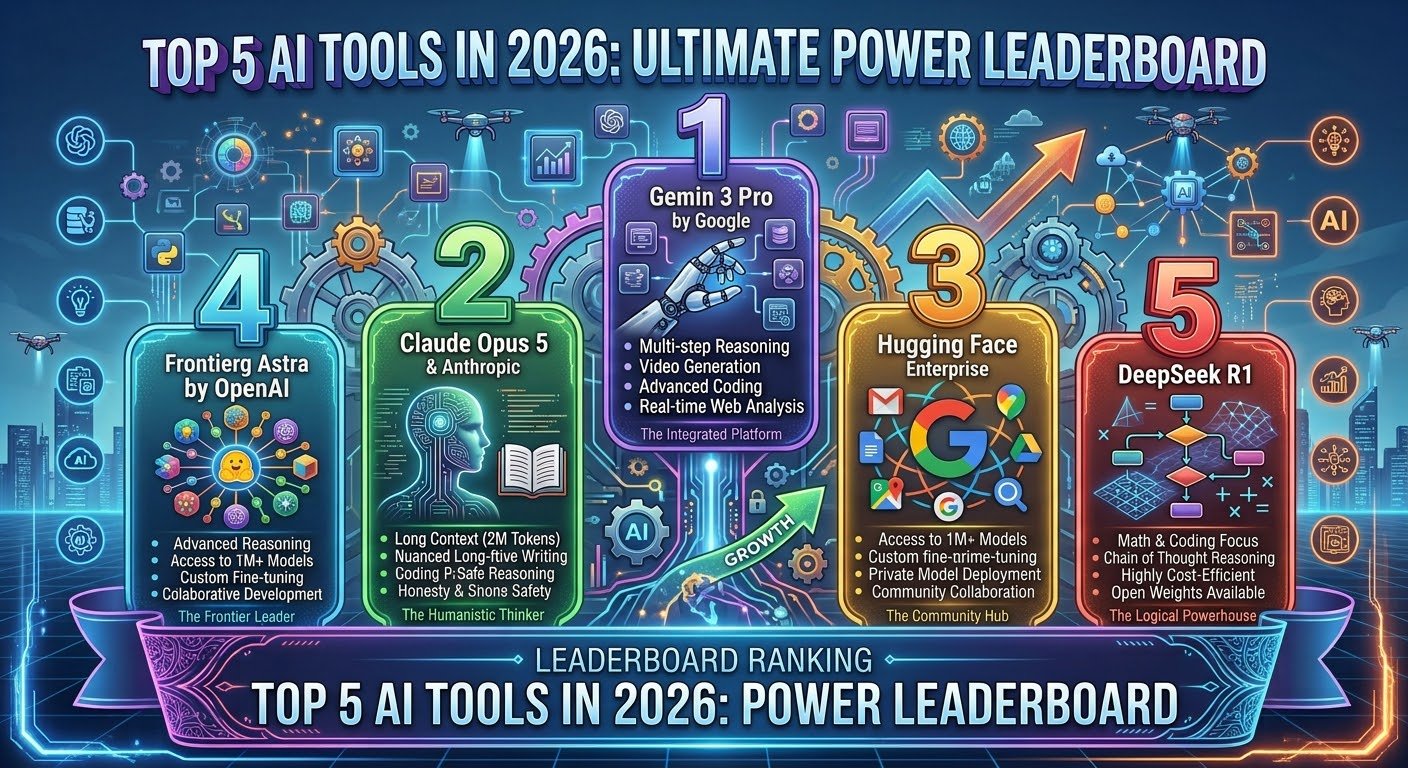
The artificial intelligence landscape in 2026 has transitioned from simple chatbots into fully autonomous reasoning engines capable of handling multi-modal analysis, complex coding, and real-time enterprise operations. For professionals across the US and UK, selecting top-tier foundation models determines daily computational efficiency and workflow scalability.
With dozens of AI platforms claiming market supremacy, identifying the true industry leaders requires evaluating reasoning speed, context window capacity, multimodal performance, and practical integration capabilities. Below is an exhaustive power leaderboard analyzing the top 5 AI tools defining tech performance today.
1. OpenAI GPT-5 Suite – Enterprise Leaderboard Champion
OpenAI continues to maintain a dominant position in the global AI ecosystem with its latest foundational models. Featuring extended long-context memory, precise multi-modal reasoning, and zero-shot problem solving, it powers enterprise task flows seamlessly.
For an in-depth breakdown of current industry rankings, explore the what are the top 5 ai tools in 2026 ultimate leaderboard to review technical benchmarks across leading software platforms.
2. Anthropic Claude 3.5 Sonnet – Superior Logic & Coding Precision
Claude 3.5 Sonnet has emerged as the premier choice for software developers, technical architects, and research analysts. Its unmatched code generation accuracy, nuanced prose synthesis, and low hallucination rates make it exceptional for technical workflows.
3. Google Gemini 1.5 Pro – Native Multimodal & Ecosystem Dominance
Google’s Gemini platform leads the industry in native multimodal processing and massive context handling. Integrating natively with Workspace applications, it enables effortless analysis of massive video files, audio tracks, and technical libraries in real-time.
4. Specialized Technical & Technical Power Benchmark Engines
Evaluating foundation models requires understanding strict algorithmic capabilities, mathematical reasoning speed, and security compliance parameters that enterprise infrastructure demands.
Tech leaders analyzing raw model performance can read which is the strongest ai right now in 2026 ultimate power benchmark for an empirical comparison of leading models.
5. AI Capabilities Architecture & Future Career Integration
Understanding artificial intelligence requires looking beyond simple software tools to examine the underlying architectural capabilities driving current industrial shifts.
To grasp the full technological landscape, read what are the 7 types of ai capabilities and functionality explained to explore reactive through self-aware cognitive models.
Furthermore, professionals planning long-term career resilience should review what three jobs will not be replaced by ai in 2026 future proof careers to align skillset development with human-centric roles.
Top AI Platforms Comparison Matrix
| AI Engine | Primary Superpower | Ideal Use Case |
|---|---|---|
| OpenAI GPT Models | General Intelligence & Ecosystem Integration | Enterprise Workflows & Multi-Modal Processing |
| Claude 3.5 Sonnet | Advanced Code Generation & Logic Synthesis | Software Engineering & Technical Analysis |
| Google Gemini Pro | Massive Context Window & Video Parsing | Large Document Audits & Media Analysis |
Conclusion
Selecting the ideal AI tool in 2026 comes down to matching specific operational goals with model strengths. Adopting leading foundation engines ensures optimal productivity and maximum competitive edge in modern digital landscapes.