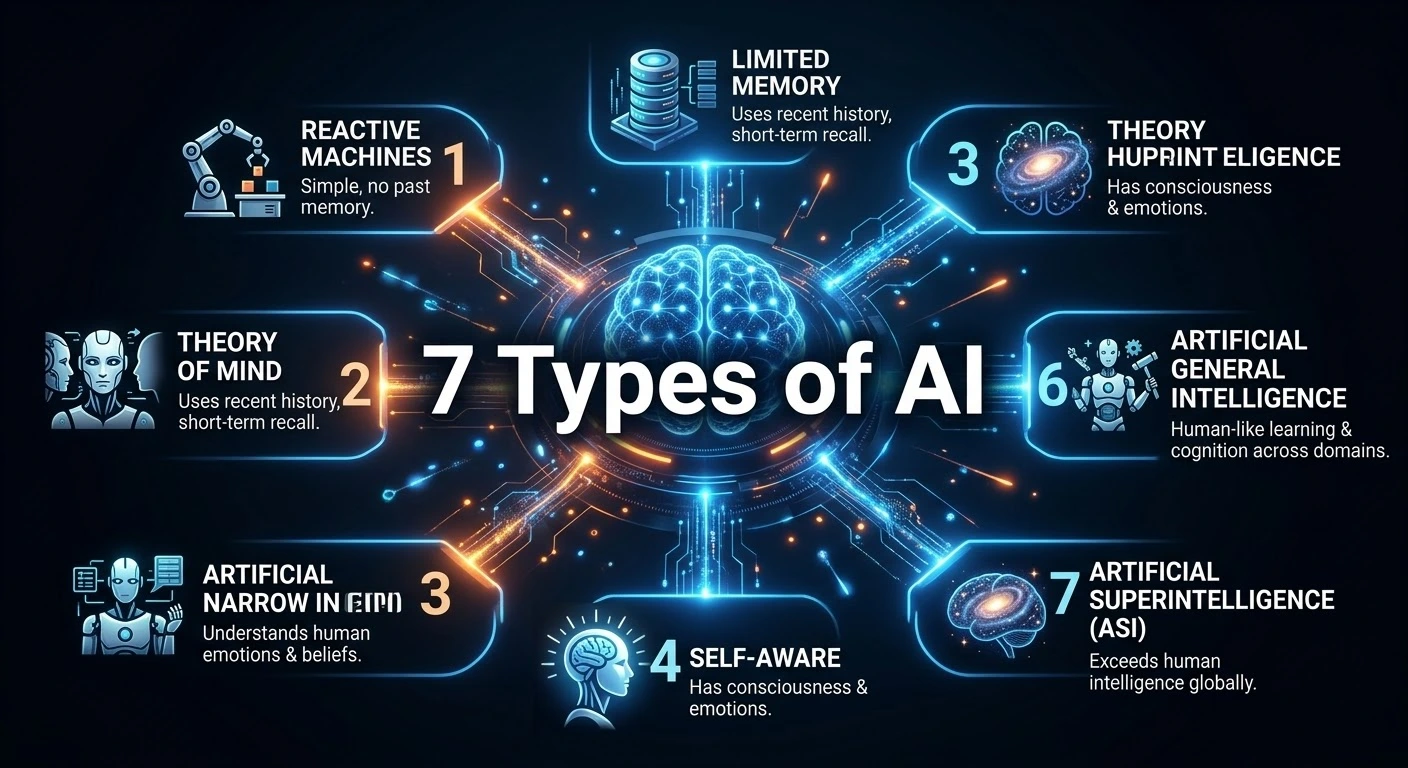
Understanding the full spectrum of artificial intelligence requires organizing systems based on their structural capabilities and functional evolution. As businesses and everyday users adapt to modern automation, asking what are the 7 types of AI helps categorize current consumer tools alongside speculative future technologies.
The Two Main Categorization Frameworks
Computer scientists group artificial intelligence into two distinct classification systems:
- Capability-Based Classification: Grouping systems by their cognitive reach, problem-solving scope, and intelligence level relative to human capabilities.
- Functionality-Based Classification: Grouping systems based on operational mechanics, memory retention, and environmental interaction abilities.
1. Artificial Narrow Intelligence (ANI / Weak AI)
Narrow AI consists of specialized systems designed to perform specific tasks within defined boundaries. ANI powers virtually all current commercial technologies, including speech recognition, recommendation algorithms, and conversational chat platforms.
2. Artificial General Intelligence (AGI / Strong AI)
General AI remains a theoretical milestone where a machine possesses human-level cognitive capabilities. AGI would independently transfer context, reason across unrelated domains, and solve unfamiliar problems without explicit reprogrammed guidance.
3. Artificial Superintelligence (ASI)
Superintelligence refers to a theoretical future era where artificial systems surpass human intelligence across all metrics, including scientific reasoning, emotional comprehension, and creative synthesis.
4. Reactive Machines
The most basic operational type, reactive machines process immediate real-time inputs without storing past experiences or building long-term memory banks. Famous examples include IBM’s historic chess-playing computer, Deep Blue.
5. Limited Memory AI
Limited memory systems temporarily store past historical data and observations to inform immediate decision-making. Self-driving vehicles rely on limited memory to track surrounding speed, distance, and road signage in real time.
6. Theory of Mind AI
A emerging technological frontier, Theory of Mind describes systems capable of understanding human mental states, emotions, beliefs, and contextual intentions to interact naturally within complex social structures.
7. Self-Aware AI
The final conceptual stage involves autonomous machines achieving self-awareness and personal consciousness. Self-aware AI would recognize its own internal state, emotions, and presence alongside human peers.
Overview of the 7 AI Types
Here is a concise reference breakdown comparing all seven categories:
| Category Type | Classification Metric | Development Status | Primary Characteristic |
|---|---|---|---|
| Narrow AI (ANI) | Capability | Fully Active Today | Task-Specific Automation |
| General AI (AGI) | Capability | In Research & Dev | Human-Level Reasoning |
| Super AI (ASI) | Capability | Theoretical Concept | Surpasses Human Ability |
| Reactive Machines | Functionality | Fully Operational | No Saved Memory Store |
| Limited Memory | Functionality | Fully Operational | Short-Term Data Recall |
| Theory of Mind | Functionality | Early Research Phase | Processes Human Emotion |
| Self-Aware AI | Functionality | Theoretical Concept | Possesses Consciousness |
Frequently Asked Questions (FAQs)
Which category do popular consumer products fall under?
Current platforms belong entirely to Narrow AI (ANI) and Limited Memory systems. If you want to review market-leading software, visit our overview of what are the top 5 AI tools in 2026.
Are there alternative models for business applications?
Entrepreneurs use custom ANI applications for marketing and administrative operations. Read our guide detailing best AI tools for small business owners in 2026 to learn practical implementations.
How can non-technical users explore modern generative systems?
Beginners can easily experiment with accessible platforms without complex setup. Explore our step-by-step walkthrough covering what AI is better than ChatGPT in 2026 for flexible options.
Final Thoughts
Distinguishing between present-day ANI systems and theoretical concepts like AGI helps ground realistic expectations. By understanding how software handles memory, data, and tasks, users can select the most effective tools for their operational goals.