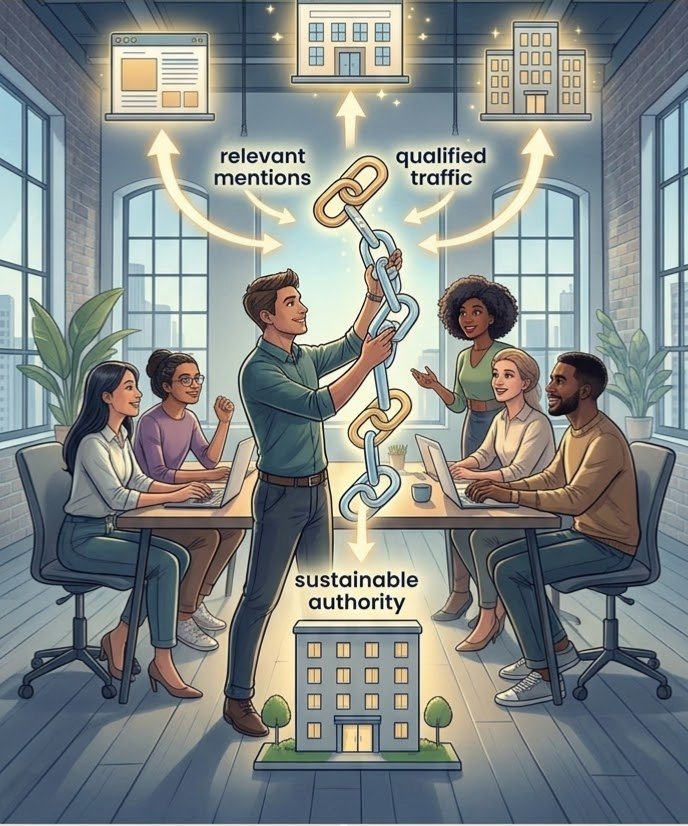
Small agencies do not need thousands of backlinks to build a credible search presence. They need relevant mentions from websites that their potential clients already trust. A focused B2B link-building strategy combines useful resources, genuine partnerships, expert contributions, and consistent outreach. The goal is to earn links because the content deserves to be referenced, not to collect random placements that add little value.
Why relevance matters more than volume
Search visibility is influenced by many signals, and links are only one part of the picture. A link from a respected industry publication, partner, association, or specialist resource can be more valuable than dozens of unrelated links. Relevance helps both search engines and readers understand why your company is worth considering.
Agencies serving US clients should begin with a clear audience: a particular industry, company size, location, or business problem. The audience determines which publications, communities, podcasts, newsletters, and partner websites are worth approaching. This guide to B2B link-building strategies for US agencies provides useful context for building a focused campaign.
Create assets people can genuinely cite
Outreach works better when you have something useful to offer. Strong linkable assets include original surveys, benchmark reports, calculators, templates, process guides, comparison pages, and practical case studies. A small agency does not need a massive research department. It can interview a carefully chosen group of customers, analyse its own anonymised results, or explain a complex process better than competing pages.
Make the asset easy to understand. Include a clear methodology, publication date, definitions, charts that can be read on mobile, and a short summary that writers can quote accurately. Add a simple embed or reference option only when it improves usability. Avoid creating a thin page whose sole purpose is to attract links.
Use partnerships without making them transactional
Existing relationships are often the safest starting point. Ask suppliers, clients, professional associations, local business groups, and complementary agencies whether a useful resource would help their audience. A client story can become a detailed case study, while a partnership with a software provider can produce an educational integration guide.
Do not demand a specific keyword-rich anchor text or offer payment for a followed link without understanding the publisher’s rules. The best partnerships are editorially natural. A link should help the reader find supporting information, and the surrounding copy should accurately describe the destination.
Build a repeatable prospecting process
Create a spreadsheet with the website name, audience, topic fit, contact details, recent relevant articles, and outreach status. Prioritise sites where your expertise solves a real content gap. A smaller list of well-researched prospects usually produces better results than a large list of generic addresses.
Look for pages that mention your industry, discuss a problem your guide solves, or publish expert commentary. Check the site’s quality manually. Signs of a healthy prospect include a consistent editorial focus, real authors, useful content, and an audience that matches your market. Avoid sites covered with unrelated sponsored posts or pages designed mainly to sell links.
Write outreach that sounds human
A good email is short, specific, and respectful. Mention the article or resource you read, explain the gap you noticed, and describe how your asset could help readers. Do not pretend to know the publisher personally, and do not use exaggerated claims about authority. One polite follow-up is usually enough; people may be busy or may not accept outside contributions.
Offer an idea rather than asking for a link immediately. For example, suggest a short expert comment, a relevant data point, or an updated section that would make the existing article more complete. If the publisher declines, thank them and move on. A professional reputation is more valuable than one placement.
Guest contributions that add real expertise
Guest content can work when it is original, useful, and written for the publication’s audience. Choose a narrow subject your team understands from experience. Include practical examples, limitations, and clear explanations. Avoid publishing the same article on several websites or inserting commercial links into every paragraph.
Use a short author biography and link to a relevant company page where appropriate. The article should stand on its own even if the reader never clicks the author link. Before submitting, review editorial requirements, attribution policies, disclosure rules, and whether the publisher uses sponsored or nofollow attributes.
Earn links through digital PR
Reporters and editors need timely, reliable expertise. Prepare a short profile of your agency’s specialists, the subjects they can discuss, and the evidence they can provide. Respond quickly to relevant requests, but never force a sales pitch into a news comment. A clear answer with a useful example can lead to coverage and long-term relationships.
You can also publish a small original study around a question that matters to your market. Share the findings with relevant journalists, newsletter writers, and professional communities. Be transparent about sample size and limitations. Honest research is more likely to be trusted and referenced.
Measure quality, not vanity numbers
Track referring domains, relevant traffic, assisted conversions, branded searches, and qualified enquiries. A link that sends five visitors who become good prospects may be more valuable than one that sends hundreds of untargeted visits. Record the page that earned the link, the relationship behind it, and any resulting business conversation.
Do not judge a campaign only by domain metrics from third-party tools. Those scores can help with prioritisation, but they are not a substitute for editorial quality, relevance, or real audience engagement. Review links regularly for broken destinations and update your own resources when facts change.
Common mistakes small agencies should avoid
- Buying large packages of unrelated backlinks.
- Using the same exact-match anchor text repeatedly.
- Sending generic outreach to websites outside the target market.
- Publishing low-value guest posts with excessive promotional links.
- Ignoring technical basics such as indexability, page speed, and internal linking.
- Expecting results immediately instead of building relationships over time.
A simple 90-day plan
In the first month, define the audience, audit existing links, and create one genuinely useful asset. In the second month, contact a small number of relevant partners and publishers with tailored ideas. In the third month, promote the asset through expert commentary, community participation, and follow-up content. Review performance at the end of the period and invest more in the approach that creates qualified traffic and credible mentions.
For agencies that want a straightforward process without inflated promises, this organic backlink strategy for small agencies is a useful companion resource. Sustainable authority comes from being helpful consistently: publish evidence, contribute expertise, and make it easy for the right people to discover and reference your work.
Supporting tools for small agency teams
Once the strategy is in place, the right operational tools can help a small team manage prospect research, outreach, deadlines, and reporting without creating unnecessary overhead. Agencies can compare AI project management tools for remote teams to coordinate campaigns across writers, outreach specialists, and account managers. For teams working with tight margins, it is also useful to review AI tools for small businesses on a budget before adding new subscriptions. Choose only tools that support a clear workflow and provide measurable value.